How to Become a Dynamics 365 Finance Functional Consultant (Step-by-Step Guide for 2026)
- October 12, 2025
- Posted by: Christian Ngah
- Category: Christian Ntanyele Ngah
By Christian Ngah (MCT) and Miselle Mombeshora (MVP)
How to Become a Dynamics 365 Finance Functional Consultant in 2026 (Complete Guide)
Introduction: Why Most People Get This Wrong
Every day, people search for how to become a Dynamics 365 consultant or how to learn Dynamics 365 Finance. Most advice focuses on certifications, courses, and system navigation.
That approach is incomplete.
Becoming a Dynamics 365 Finance Functional Consultant is not just about learning a system. It is about understanding business processes, solving problems, and translating requirements into practical solutions.
This guide provides a structured and realistic roadmap designed to help you enter and grow within the Dynamics 365 ecosystem.
Step 1 – Understand the Role Before You Start
Before beginning your learning journey, you must understand the role itself.
A Dynamics 365 Functional Consultant is responsible for:
- Bridging the gap between business stakeholders and technical teams
- Translating business requirements into system solutions
- Designing and improving business processes
The Three Main Dynamics 365 Paths
Customer Engagement (CRM)
Sales, Customer Service, Marketing
Finance and Operations (ERP)
Finance, Supply Chain, Manufacturing
Business Central
Small and medium-sized business operations
If your focus is finance, your path will be Dynamics 365 Finance and Operations.
Step 2 – The 30/70 Rule That Defines Success
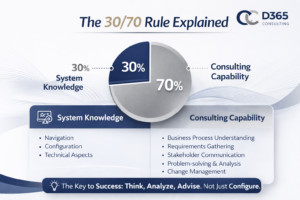
A common misconception is that mastering the system is enough to succeed.
In reality:
- 30 percent of the role is system knowledge
- 70 percent is consulting capability
Core Consulting Skills
To succeed, you must develop:
- Business process understanding
- Requirements gathering
- Stakeholder communication
- Problem-solving and analytical thinking
- Change management
- Testing and validation
A strong consultant is defined by their ability to think, not just configure.
Step 3 – The Real Entry Point Into Dynamics 365
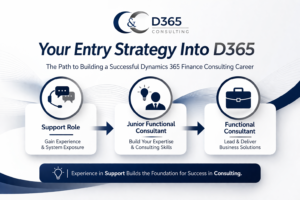
Many candidates attempt to enter directly as Functional Consultants. This often leads to repeated rejection.
The most effective path is structured progression:
Support → Junior Functional Consultant → Functional Consultant
This approach aligns with how organisations evaluate experience and capability.
Step 4 – Why Support Roles Are the Strongest Foundation
A Dynamics 365 support role provides exposure that certifications cannot offer.
What You Gain in Support
- Exposure to real system issues
- Understanding of financial processes in live environments
- Experience with configuration errors and system behaviour
- Insight into how users interact with the system
This stage builds practical understanding and confidence.
Understanding Support Levels
First Line Support
Handles basic user queries, access issues, and navigation support
Second Line Support
Focuses on functional issues, configuration problems, and system behaviour
Third Line Support
Deals with technical, development, and complex system issues
The most valuable experience for progression comes from second line support.
Step 5 – How Support Experience Translates Into Consulting Skills
Consistent exposure in support roles leads to a shift in thinking.
You begin to:
- Identify root causes instead of symptoms
- Recognise patterns across different scenarios
- Understand the relationship between business processes and system behaviour
- Communicate effectively with both users and technical teams
This is the stage where you transition from learning to applying.
Step 6 – Transitioning Into Project-Based Work
To move forward, you must actively position yourself within project environments.
Areas to Get Involved In
- Requirements gathering sessions
- User Acceptance Testing (UAT)
- Data migration activities
- Workshop participation
- End-user training support
This exposure bridges the gap between support and consulting.
Step 7 – Understand the Functional Consultant Lifecycle
A Functional Consultant operates across the full project lifecycle.
Key Phases
- Requirements gathering
- Solution design
- Fit-gap analysis
- Documentation (Functional Design Documents and process flows)
- Testing (UAT and System Integration Testing)
- Deployment and post-go-live support
Understanding this lifecycle is essential for progression.
Step 8 – Learn Dynamics 365 Finance With Structure
Product knowledge remains important but must be approached strategically.
Core Modules to Focus On
- General Ledger
- Accounts Payable
- Accounts Receivable
- Cash and Bank Management
- Fixed Assets
Effective Learning Approach
Avoid focusing only on system navigation.
Instead:
- Understand end-to-end process flows
- Relate system actions to business outcomes
- Practise real-life scenarios
Always connect process, system behaviour, and business impact.
Step 9 – The Most Common Mistake to Avoid
One of the biggest barriers to success is lack of focus.
Many learners switch between different areas without gaining depth.
The Principle
Select one path
Remain consistent
Develop deep expertise
Depth leads to confidence and employability.
Step 10 – Realistic Career Timeline
A practical progression timeline is as follows:
0 to 6 months
Build foundational knowledge and enter a support role
6 to 12 months
Handle issues independently and gain exposure to projects
12 to 24 months
Transition into a Junior Functional Consultant role
2 to 3 years
Operate as a Functional Consultant
This progression reflects real industry expectations.
Final Thoughts
Success in Dynamics 365 consulting is not driven by certifications alone.
It is built through:
- Structured learning
- Real-world experience
- Consistent effort
- Strong understanding of business processes
Those who follow a clear path and remain consistent are the ones who succeed.
Frequently Asked Questions (FAQ)
Do I need MB-310 to become a Dynamics 365 Functional Consultant?
It is not mandatory, but it is highly recommended as it demonstrates foundational knowledge of Dynamics 365 Finance.
Can I become a Functional Consultant without prior experience?
Yes, but you should begin with a support role or junior position to build practical experience.
What is the best entry-level role in Dynamics 365?
A second line support role provides the most relevant exposure for progression into consulting.
How long does it take to become a Functional Consultant?
Typically between two to three years with consistent learning and practical experience.
Is Dynamics 365 a good career in the UK?
Yes. Demand for Dynamics 365 Finance professionals continues to grow across industries, making it a strong long-term career path.
If you are serious about becoming a Dynamics 365 Finance Functional Consultant, focus on structured progression, real experience, and consistent learning.
This approach will position you for long-term success in the field.